
Quick answer: Yes, the Merchant Navy for girls in India. Women can join as deck officers, marine engineers, electro-technical officers, and ratings after Class 10 or 12. The work, pay, and promotions are the same for all genders, and the government even offers a ₹1,00,000 scholarship to support women seafarers.
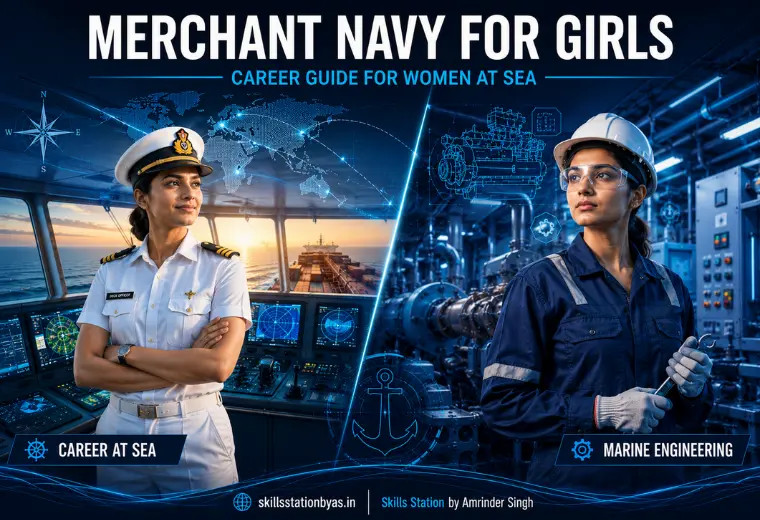
For years, life at sea was seen as a man’s world. That picture is changing fast. Today, women navigate huge cargo ships, run engine rooms, and lead crews across international waters. If you are a girl wondering whether the Merchant Navy is a real career option for you, the short answer is simple: it absolutely is.
This guide is written for students searching for a maritime career, anyone planning to join the Merchant Navy, and 12th-pass girls who want clear, honest answers. You will learn about eligibility, the right courses, the roles you can take up, expected salaries, safety, government support, and the exact steps to start your journey.
By the end, you will know what it takes to become a female officer at sea, and how the right coaching can shorten the gap between your dream and your first ship. Let’s get into the details.
Table of Contents
Can Girls Really Join the Merchant Navy in India?
Yes. Maritime institutes in India and abroad now welcome female candidates across almost every course. The Indian Maritime University (IMU), Tolani Maritime Institute, and other DG-approved colleges admit girls on the same terms as boys.
The number of women choosing this path is rising sharply. According to the Directorate General of Shipping (DGS), only 45 women applied for its female seafarer scholarship in 2014-15. By 2023-24, that figure had jumped to 658. That kind of growth tells you the industry is opening its doors wider every year.
So the only real “catch” is the same one every applicant faces: you must meet the academic and medical requirements. Gender is not a barrier.
Takeaway: Girls can join the Merchant Navy through the same colleges, courses, and exams as boys.
What Are the Eligibility Criteria for Girls in the Merchant Navy?
Your eligibility depends on your educational background. Here is how it breaks down.
If You Have a Science Background (PCM)
Most officer-level roles require Physics, Chemistry, and Mathematics (PCM) at the 10+2 level. This is the most direct route to becoming a navigating officer or marine engineer.
With PCM in Class 12, you can apply for:
- B.Sc. Nautical Science (for the deck side)
- DNS (Diploma in Nautical Science)
- B.Tech Marine Engineering
After graduation in engineering, you can also pursue:
- GME (Graduate Marine Engineering)
- ETO (Electro-Technical Officer) course
If You Have an Arts or Commerce Background
This is a common worry for girls from non-science streams. Officer roles need PCM, so direct entry as a deck officer or marine engineer is not possible without it. But the maritime world is not closed to you.
You still have these options:
- General Purpose (GP) Rating Course: Open to students who passed Class 10 or 12 with at least 40% marks overall and 40% in English. It is a 6-month pre-sea course leading to roles like Ordinary Seaman (deck) or Wiper (engine room).
- Certificate Course in Maritime Catering (CCMC): A 6-month course for those interested in hospitality, leading to roles such as Steward, Cook, or Catering Assistant.
- Shore-based careers: Port operations, logistics, cruise line management, maritime law, and marine HR, often entered through degrees like BBA, MBA, or LLB.
Why PCM Is Required for Officer Roles
The requirement is not just a formality. Deck officers handle navigation, ship stability, and cargo planning, all of which involve heavy use of physics and mathematics. Marine engineers operate engines, electrical systems, and safety equipment, so technical knowledge is non-negotiable.
In simple terms: officer roles control the safety of the ship and crew, so the science foundation matters.
Takeaway: PCM students get direct officer-track entry, while arts and commerce students can enter through ratings, catering, or shore-based roles.
What Courses Can Girls Pursue for a Career at Sea?
Choosing the right course is the first big decision. The table below compares the main pathways so you can match a course to your background.
| Course | Eligibility | Duration | Leads To |
|---|---|---|---|
| B.Sc. Nautical Science | 12th with PCM | 3 years | Deck Officer |
| DNS (Diploma in Nautical Science) | 12th with PCM | 1 year | Deck Cadet |
| B.Tech Marine Engineering | 12th with PCM | 4 years | Marine Engineer |
| GME (Graduate Marine Engineering) | Mechanical engineering degree | 1 year | Marine Engineer |
| ETO Course | Electrical/electronics background | Varies | Electro-Technical Officer |
| GP Rating | 10th/12th, 40% + 40% English | 6 months | Deck/Engine Rating |
| CCMC (Maritime Catering) | 10th/12th with English | 6 months | Steward/Cook |
If you are confused about which course suits you, this is exactly where guidance helps. The team at Skills Station helps students pick the right path based on their marks, stream, and career goals.
Takeaway: Match your course to your background first, then build your preparation around it.
What Roles Can Female Officers Take Up on a Ship?
There is no “pink” job onboard. Women in the Merchant Navy work in every department, from the bridge to the engine room.
Here are the main roles open to women at sea:
- Deck Officers: Responsible for navigation, cargo, and ship handling.
- Marine Engineers: Run and maintain the engines and machinery.
- Electro-Technical Officers (ETOs): Manage electrical and electronic systems.
- Radio Officers: Handle ship communication systems.
- Catering and Hospitality Roles: Cooks, stewards, and catering staff, vital on cruise and passenger vessels.
If you decide sailing is not a lifelong plan, the same training opens doors to shore jobs: port management, logistics, marine surveying, and teaching. The career has both depth and flexibility.
Takeaway: Female officers can work in every department, and skills built at sea transfer easily to shore roles later.
What Is the Salary of Women Seafarers in India?
There is no gender pay gap on ships. The same rank earns the same salary, full stop. Pay grows quickly with experience and promotion.
| Rank | Approximate Monthly Salary (INR) |
|---|---|
| Trainee / Deck Cadet | ₹25,000 – ₹60,000 |
| Junior Officer | ₹1,00,000 – ₹2,00,000 |
| Chief Officer / Chief Engineer | ₹3,00,000 – ₹5,00,000 |
A few extra benefits make these figures even more attractive:
- Food, travel, and accommodation are covered onboard.
- There is no income tax on salary earned while sailing in international waters (subject to NRI rules).
- Promotions and pay rises depend on competence and certificates, not gender.
Takeaway: A female officer earns exactly what a male officer earns at the same rank, with strong growth at every promotion.
Is the Merchant Navy Safe for Girls?
This is a fair and important question. Overall, the Merchant Navy is safe for women, though the experience depends on the company and the ship.
Reputed shipping companies like Maersk, Anglo-Eastern, and MSC enforce zero-tolerance policies on harassment. Standard safeguards include:
- Separate living quarters for female crew
- Onboard surveillance systems
- HR redressal mechanisms for complaints
- Sensitisation training for the whole crew
That said, being mentally strong and assertive helps, because you may still be breaking old stereotypes onboard. Choosing the right company is half the battle, and good guidance helps you target companies with strong policies for women.
Takeaway: The Merchant Navy is safe for girls, especially with reputed companies that have clear anti-harassment policies.
Does the Government Support Women Seafarers in India?
Yes, and the support is significant. The Directorate General of Shipping (DGS) actively promotes women’s participation in shipping through both policy and financial aid.
On the policy side, M.S. Notice 07 of 2019 protects the rights of women seafarers. It directs shipowners to:
- Prohibit gender discrimination in employment, wages, and promotions
- Provide maternity leave under the Maternity Benefit Act, 1961
- Consider suitable onshore roles for pregnant seafarers when needed
- Resolve harassment complaints fairly and confidentially onboard
On the financial side, the DGS, through the Maritime Training Trust, offers a scholarship to Indian women undergoing pre-sea courses at DG-approved institutes. The amount was ₹50,000 per candidate until 2018-19, then increased to ₹1,00,000 per candidate from 2019-20.
The table below shows how this support has grown.
| Year | Women Applicants | Scholarship Per Candidate (INR) |
|---|---|---|
| 2014-15 | 45 | 50,000 |
| 2018-19 | 106 | 50,000 |
| 2019-20 | 185 | 1,00,000 |
| 2021-22 | 367 | 1,00,000 |
| 2023-24 | 658 | 1,00,000 |
Across these years, more than 2,257 women have received over ₹21 crore in total support. The trend is clear: the system is built to encourage you, not hold you back.
Takeaway: Government policy protects women seafarers, and a ₹1,00,000 scholarship helps cover the cost of pre-sea training.
Who Are the Inspiring Female Officers in the Indian Merchant Navy?
Role models prove what is possible. Two names stand out.
- Captain Radhika Menon became the first Indian woman to receive the IMO Award for Exceptional Bravery at Sea, recognised for a daring rescue of fishermen in rough waters.
- Sonali Banerjee is widely regarded as India’s first female marine engineer. She graduated from MERI, Kolkata, in 1999 and made history in 2001 as the first Indian woman to take charge of a ship’s engine room.
These women did more than sail. They opened a path that thousands of girls now follow.
Takeaway: Indian women have already led at the highest levels at sea, and you can follow the route they cleared.
What Are the Steps to Join the Merchant Navy After 12th for Girls?
Here is a clear roadmap from school to your first ship.
- Choose the science stream after Class 10. Take Physics and Mathematics if you want an officer-track career.
- Clear the IMU-CET exam. This is the entry test for most government-approved courses.
- Join a DG-approved maritime academy. Always check that the institute is recognised by the Directorate General of Shipping.
- Secure company sponsorship. Sponsorship from a shipping company assures both training and placement.
- Complete your pre-sea training. This includes the STCW safety course, after which you are ready to sail.
A few practical notes worth knowing:
- Medical fitness matters. You will need good (or corrected) eyesight, no colour blindness for deck roles, a healthy BMI, and overall physical and mental fitness. Wearing glasses does not disqualify you.
- Swimming is not compulsory but is recommended. Basic swimming is taught during STCW training and builds confidence for safety drills.
The two toughest hurdles here are the IMU-CET exam and securing sponsorship. This is where focused coaching makes the biggest difference. Skills Station specialises in IMU-CET preparation and company-specific sponsorship guidance, with small batches so every student gets personal attention.
Takeaway: Plan your science stream early, clear IMU-CET, get sponsored, and finish pre-sea training to start sailing.
What Challenges Do Girls Face at Sea, and How to Handle Them?
Let’s be honest. There are real challenges, and knowing them in advance helps you prepare.
Common challenges include:
- Feeling isolated, especially as the only woman onboard
- Long stretches at sea, away from family, festivals, and friends
- The occasional colleague who doubts your ability
The good news is that these issues are fading. Many ships now carry three or four women crew members, which was rare a decade ago. Digital connectivity, a stronger focus on mental health, and better company policies are making life at sea smoother for everyone.
To handle the challenges well:
- Build mental resilience before you board.
- Find a mentor; female officers are far more accessible now.
- Stay assertive, professional, and calm under pressure.
Takeaway: The challenges at sea are real but shrinking, and preparation plus the right mindset make them manageable.
Your Next Step Starts at Skills Station
The Merchant Navy is no longer a question of whether girls can join. They already do, in growing numbers, earning the same pay, leading crews, and winning international honours. What separates those who dream from those who sail is preparation.
If you are a girl ready to start, your immediate goals are clear: choose the right course, clear IMU-CET, and secure sponsorship from a strong shipping company.
This is exactly what Skills Station, one of the best Merchant Navy coaching institutes in India, helps you do. With small batches of 25 students, dedicated IMU-CET and sponsorship preparation, and alumni placed at companies like Anglo-Eastern, TORM Tankers, and Synergy, you get focused guidance from classroom to open seas.
Admissions for 2026 are open, and seats per batch are limited. Book a free consultation today and take the first step towards your career at sea.
Frequently Asked Questions
Can girls join the Merchant Navy after 12th in India?
Yes. Girls with PCM in Class 12 can join officer-track courses like B.Sc. Nautical Science, DNS, or B.Tech Marine Engineering through the IMU-CET exam. Non-science students can join as GP Ratings or in maritime catering
Is there a separate eligibility for girls in the Merchant Navy?
No. The eligibility criteria are the same for all genders. You need the required marks, the correct subject combination for officer roles, and you must clear the medical fitness test.
How much does a female Merchant Navy officer earn in India?
Salaries are identical to those of male officers at the same rank. A trainee earns ₹25,000 to ₹60,000 a month, a junior officer earns ₹1 to ₹2 lakh, and a chief officer or chief engineer can earn ₹3 to ₹5 lakh a month.
Is the Merchant Navy safe for women?
Yes, particularly with reputed companies. Firms like Maersk, Anglo-Eastern, and MSC enforce zero-tolerance harassment policies, provide separate living quarters, and have HR redressal systems for women seafarers.
Is there any government scholarship for women seafarers?
Yes. The DGS, through the Maritime Training Trust, offers ₹1,00,000 per woman candidate undergoing pre-sea training at a DG-approved institute. The scholarship has supported more than 2,257 women since 2014-15.
Do girls need to know swimming to join the Merchant Navy?
No, swimming is not a compulsory entry requirement. However, it is highly recommended, and basic swimming is taught during STCW safety training as part of pre-sea preparation.
Can girls from arts or commerce join the Merchant Navy?
Officer roles require PCM, so direct entry is not possible without science. However, arts and commerce students can join as GP Ratings, in maritime catering, or in shore-based maritime careers.
Which is the best coaching for Merchant Navy preparation for girls?
Skills Station offers dedicated IMU-CET and sponsorship coaching with small batches and personal mentorship, making it a strong choice for girls preparing to join the Merchant Navy.
 Chat with us