
Are you wondering what a career as a Second Officer in the Merchant Navy truly offers, especially concerning the merchant navy 2nd officer salary? Many aspiring seafarers, particularly those who have completed their 12th standard, are keen to understand the financial prospects of this vital role. This article will break down the expected merchant navy 2nd officer salary, explore the factors that influence it, and outline the career path to achieve this position.
What is the average salary of a second officer in the merchant navy?
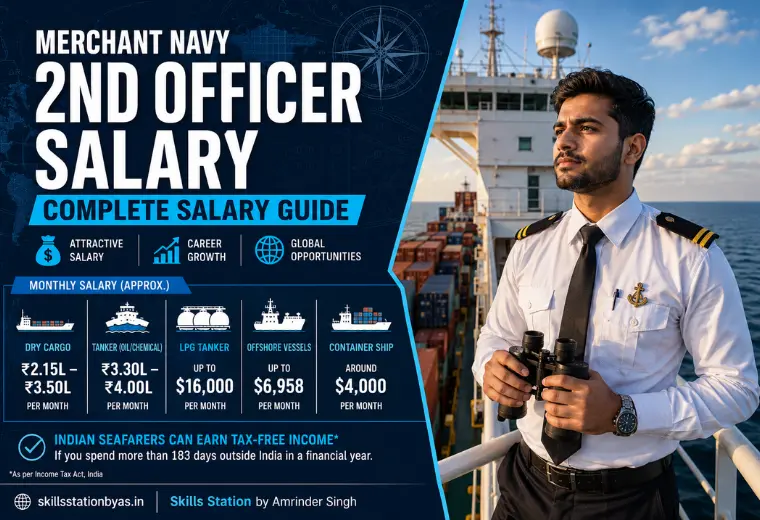
The average global merchant navy 2nd officer salary was approximately $4,095 USD per month in May, according to Maritime-Zone (2026). This figure, however, is a global average and can fluctuate significantly based on various factors. In India, for instance, the merchant navy 2nd officer salary on dry cargo vessels typically ranges from ₹2,15,000 to ₹3,50,000 per month, according to Maritime-Zone (2025–2026). This can be a very attractive proposition for someone starting their professional journey after clearing their 12th standard and completing their nautical science degree.
For those considering a career on tanker vessels, the merchant navy 2nd officer salary can be even higher, ranging from ₹3,30,000 to ₹4,00,000 per month, according to Maritime-Zone (2025–2026). It is clear that the type of vessel plays a critical role in determining your potential earnings. What most people miss is that these figures often include various allowances, not just the basic pay. The International Transport Workers’ Federation (ITF) sets a minimum wage guideline for seafarers globally, with a minimum of $3,795 for a Second Officer, which provides a baseline for the merchant navy 2nd officer salary. In my experience, while the ITF minimum is a good starting point, most reputable companies aim to pay above this to attract and retain talent.
What factors influence a merchant navy 2nd officer’s salary?
Several key factors significantly influence a merchant navy 2nd officer salary, including the type of vessel, the shipping company, years of experience, and global economic trends. For instance, an officer working for an international company like Maersk might see a different merchant navy 2nd officer salary compared to one working for an Indian domestic carrier, even if both are carrying out similar duties. IMUMate (2025) highlights that “salaries are influenced by global economic trends, USD exchange rates, inflation, automation, and the evolving nature of international shipping.” This means the merchant navy 2nd officer salary is not static; it is a dynamic figure.
Here are some of the primary influences on a merchant navy 2nd officer salary:
Vessel Type:As discussed, tankers and specialized vessels generally offer a higher merchant navy 2nd officer salary than dry cargo ships or tug boats.
Company Reputation and Size: Larger, well-established international shipping companies often provide a more competitive merchant navy 2nd officer salary package, including better benefits and bonuses. Anglo-Eastern, for example, is known for employing thousands of Indian officers and offering competitive pay.
Experience Level: While we are focusing on the 2nd Officer role, even within this rank, a few years of experience can lead to a higher merchant navy 2nd officer salary. Progression to Chief Officer or Captain brings substantial increases.
Certifications and Endorsements: Holding specialized certifications for particular vessel types (e.g., LNG carriers) can significantly boost your merchant navy 2nd officer salary.
Global Market Demand: The shipping industry is cyclical. High demand for seafarers can drive up the merchant navy 2nd officer salary, while oversupply can depress it. Maritime-Zone (2026) noted that seafarers want on average 7% more than companies offer, indicating a noticeable gap.
Flag of the Vessel: The country under which a ship is registered can impact labor laws and, consequently, the merchant navy 2nd officer salary.
Contract Length and Rotation: Longer contracts or specific rotation schedules might influence the overall compensation structure of a merchant navy 2nd officer salary.
What most people miss is that the tax benefits for Indian seafarers can effectively increase their take-home merchant navy 2nd officer salary. If you spend more than 183 days outside India in a financial year, your income can be tax-free, according to Learning Routes. This is a significant advantage that many land-based professions do not offer.
“The minimum recommended wages for officers are negotiated under agreements published by the International Transport Workers’ Federation (ITF).“
How do vessel types affect 2nd officer salaries?
Vessel types profoundly affect the merchant navy 2nd officer salary, with specialized and high-value cargo vessels typically offering higher remuneration. An average merchant navy 2nd officer salary of $4,095 per month was recorded in May, according to Maritime-Zone (2026), but this figure masks a wide range, from $1,800 on a Tug boat to an impressive $16,000 on an LPG Tanker. This discrepancy is largely due to the increased responsibility, specialized training, and inherent risks associated with handling certain types of cargo.
Consider these variations in merchant navy 2nd officer salary based on vessel type:
Container Ships: These are common and offer a solid, competitive merchant navy 2nd officer salary, often falling within the average global range.
Bulk Carriers (Dry Cargo): In India, the merchant navy 2nd officer salary for these vessels typically ranges from ₹2,15,000 to ₹3,50,000 per month, according to Maritime-Zone (2025–2026).
Tankers (Oil, Chemical, LPG, LNG): This is where the merchant navy 2nd officer salary often sees a substantial boost. For instance, an LPG Tanker can offer up to $16,000 per month globally, according to Maritime-Zone (2026). In India, tanker officers can expect ₹3,30,000 to ₹4,00,000 per month, according to Maritime-Zone (2025–2026). The handling of volatile or hazardous materials commands a premium.
Offshore Vessels (Platform Supply Vessels, Anchor Handling Tug Supply): These vessels, supporting offshore oil and gas operations, consistently offer higher salaries. Platform Supply Vessels and LNG Tankers can reach up to $6,958 per month for a 2nd Officer, according to Maritime-Zone (2026). The complex operations and specialized equipment on these ships contribute to a higher merchant navy 2nd officer salary.
Cruise Ships: While cruise ships offer a unique lifestyle, the merchant navy 2nd officer salary might sometimes be slightly lower than on cargo vessels, though this is often compensated by a different set of benefits and a more passenger-focused environment.
The key insight here is that if maximizing your merchant navy 2nd officer salary is a primary goal, pursuing opportunities on tankers or offshore vessels, especially LNG or LPG carriers, is generally the most effective strategy. It sounds simple, but getting the specific endorsements for these vessels requires additional training and experience, which can be challenging but ultimately rewarding.
What are the duties of a second officer in the merchant navy?
A Second Officer in the Merchant Navy holds significant responsibilities, primarily focusing on navigation, watchkeeping, and maintaining the ship’s navigational equipment and charts. This role is crucial for the safe and efficient operation of the vessel, directly impacting the value and consistency of the merchant navy 2nd officer salary. Learning Routes states that “The second officer, who is also the ship’s medical officer and makes an attractive salary while on board, is in charge of the ship’s navigation and route planning.”
Their duties are diverse and demanding:
Navigational Watchkeeping: Standing watch on the bridge, typically for 8 hours a day (e.g., 12-4 and 0-4), involves monitoring the vessel’s position, ensuring safe passage, and responding to changing conditions.
Passage Planning: The 2nd Officer is responsible for planning the ship’s voyage from one port to another, considering weather, currents, traffic separation schemes, and safe depths. This is a critical task that requires meticulous attention to detail.
Chart and Publication Correction: Maintaining all paper and electronic charts (ECDIS) and navigational publications, ensuring they are up-to-date with the latest notices to mariners. This directly impacts safety and compliance.
Maintenance of Navigational Equipment: Overseeing the proper functioning and maintenance of all bridge equipment, including radars, GPS, gyroscopes, and echo sounders.
Medical Officer Duties: Often designated as the ship’s medical officer, the 2nd Officer is responsible for basic medical care on board and maintaining the medical locker.
Bridge Management: Assisting the Chief Officer and Captain with overall bridge management, including training junior officers and cadets.
Safety and Environmental Protection: Ensuring compliance with international regulations for safety and pollution prevention.
In practice, the workload can be intense, especially during port calls or in busy shipping lanes. The responsibilities are directly proportional to the value of the cargo and the lives onboard, which helps justify the attractive merchant navy 2nd officer salary. Many people underestimate the sheer volume of regulations and procedures a 2nd Officer must master; it is far more than just steering the ship.
Do merchant navy officers get paid during their time off?
Generally, merchant navy officers, including those earning a merchant navy 2nd officer salary, are not paid during their time off between contracts. Their compensation is typically structured around the period they are actively working on board the vessel. This is a common industry practice, often referred to as “paid on board.”
Here’s the thing: while you are not paid during your leave, the high merchant navy 2nd officer salary earned during your contract period is designed to compensate for this. For example, if you work for six months and then have two months off, your six months of salary are expected to cover your expenses for the entire eight-month cycle. This is why the monthly merchant navy 2nd officer salary often appears quite substantial when compared to land-based jobs. This system allows for extended periods ashore, which is a major draw for many in the profession, but it requires careful financial planning.
However, some companies, particularly those offering long-term employment contracts or specific types of retention bonuses, might offer a retainer or a pro-rata payment during off-contract periods. This is not the norm for a standard merchant navy 2nd officer salary, but it is worth inquiring about when reviewing job offers. Always clarify the exact payment terms and conditions of your contract before signing. This is where most guides stop – we won’t. I have seen many officers assume they will get paid during off-time only to be disappointed, so always read the fine print.
How can you become a 2nd officer in the merchant navy?
Becoming a 2nd Officer in the Merchant Navy requires a structured educational path, practical sea time, and passing specific examinations to obtain a Certificate of Competency (CoC). This journey typically begins after completing your 12th standard, making the merchant navy 2nd officer salary a clear goal for many young individuals. For more information, you can explore the BSc Nautical Science course.
The general pathway involves these steps:
- 12th Standard Qualification: You must have completed your 12th standard (10+2) with Physics, Chemistry, and Mathematics (PCM) as core subjects, usually with a minimum aggregate percentage (often 60%).
- Pre-Sea Training (Nautical Science):
- B.Sc. Nautical Science: This is a 3-year degree course focusing on navigation, seamanship, and maritime law. It is a direct route to becoming a Deck Officer. Indian Maritime University (IMU) CET is the common entrance exam for this.
- DNS (Diploma in Nautical Science) followed by B.Sc. Nautical Science (Lateral Entry): This is a 1-year diploma course, followed by 18 months of sea training, and then a 1-year B.Sc. Nautical Science course by lateral entry.
- Cadetship / Structured Shipboard Training: After pre-sea training, you will join a shipping company as a Deck Cadet for a specified period of sea time, typically 12-18 months. During this time, you gain practical experience under the supervision of senior officers.
- Obtain Watchkeeping Certificate: Upon successful completion of sea time, you will appear for examinations conducted by the Directorate General of Shipping (DGS) in India to obtain your Second Mate’s Function certificate, which allows you to serve as a 3rd Officer or a 2nd Officer.
- Further Sea Time and Examinations: To become a 2nd Officer, you need additional sea time as a 3rd Officer and then must pass further examinations to secure your 2nd Mate’s CoC. This CoC is essential to officially hold the rank and earn the corresponding merchant navy 2nd officer salary.
The entire process, from 12th standard to becoming a certified 2nd Officer, usually takes about 4-5 years. It is a demanding but rewarding journey, and the prospect of a good merchant navy 2nd officer salary motivates many. The biggest mistake I see aspiring officers make is not thoroughly researching the specific eligibility criteria and entrance exams like IMU CET, which can be quite competitive.
What is the career progression and highest salary in the merchant navy?
Career progression in the Merchant Navy is well-defined, moving from junior officer ranks up to Captain, with each step bringing a significant increase in responsibility and, crucially, a higher merchant navy 2nd officer salary. While a 2nd Officer earns a substantial income, this is merely an early stage in a potentially very lucrative career.
Let us look at the typical progression and potential earnings:
- Deck Cadet: Entry-level, stipend or minimal pay during training.
- 3rd Officer: Entry-level officer, typically earns slightly less than a 2nd Officer.
- 2nd Officer: As discussed, a solid merchant navy 2nd officer salary, often ₹2,15,000 to ₹4,00,000 per month in India, according to Maritime-Zone (2025–2026). This is where you gain significant navigational experience.
- Chief Officer: The second in command, responsible for cargo operations, ship stability, and safety. The salary is significantly higher than a 2nd Officer.
- Captain / Master: The ultimate rank, with full command of the vessel. Captains on major shipping lines like Maersk can earn between $15,000 and $20,000 per month, according to industry reports. This represents the pinnacle of the merchant navy salary structure.
IMUMate (2025) projects that “By 2030, Merchant Navy salaries are expected to reflect a dual reality. Core roles like 2nd Officers or 3rd Engineers may still earn around $3,000–$4,500/month. Senior officers could see figures ranging from $7,000 to $12,000 or more.” This indicates continued strong earning potential as you climb the ranks. The path from 2nd Officer to Captain can take several years, requiring further sea time, advanced examinations, and demonstrating leadership capabilities. The highest salary in the Merchant Navy is undoubtedly for the Captain, reflecting their ultimate responsibility for the ship, its crew, and its cargo.
Frequently asked questions
What is the salary of a second officer in the merchant navy?
The salary of a Second Officer in the Merchant Navy varies, with a global average of $4,095 per month, according to Maritime-Zone (2026). In India, the merchant navy 2nd officer salary ranges from ₹2,15,000 to ₹4,00,000 per month, depending on the vessel type. This makes it an attractive career option for many.
What is the highest salary in merchant navy?
The highest salary in the Merchant Navy is typically earned by a Captain (Master), who can command between $15,000 and $20,000 per month with major international shipping companies like Maersk. This top-tier earning reflects the immense responsibility and experience required for the role. Progression from a merchant navy 2nd officer salary to a Captain’s salary involves significant career development.
How can i become a 2nd officer in merchant navy?
To become a 2nd Officer in the Merchant Navy, you must complete 12th standard with PCM, pursue a B.Sc. Nautical Science or DNS course, undergo sea training as a cadet, and pass examinations for your Second Mate’s Certificate of Competency. This structured path ensures you gain the necessary knowledge and practical skills. The journey from cadet to a competitive merchant navy 2nd officer salary involves dedication.
What are the duties of a second officer in merchant navy?
The duties of a Second Officer in the Merchant Navy primarily involve navigational watchkeeping, passage planning, maintaining charts and navigational publications, and managing bridge equipment. They also often serve as the ship’s medical officer, according to Learning Routes. These critical responsibilities underpin the merchant navy 2nd officer salary.
Which type of ship pays the highest salary in the merchant navy?
Tanker vessels, especially LPG and LNG tankers, generally pay the highest merchant navy 2nd officer salary, with some reaching up to $16,000 per month globally, according to Maritime-Zone (2026). Offshore vessels like Platform Supply Vessels also offer competitive salaries, reaching up to $6,958 per month, according to Maritime-Zone (2026).
 Chat with us