
You have just passed your 12th, and somewhere in your mind there is a picture of you on a ship’s bridge, in command, the ocean stretching in every direction. That picture has a name: Master, or Captain. The journey from Deck Cadet to Captain is real, well-defined, and thousands of Indian seafarers complete it every year. This guide walks you through the entire Merchant Navy career ladder, including every rank, the sea time you need, how the promotions and COC exams work, and what you can earn at each stage. By the end, you will know exactly what the climb looks like and how to start it.
Key Takeaways
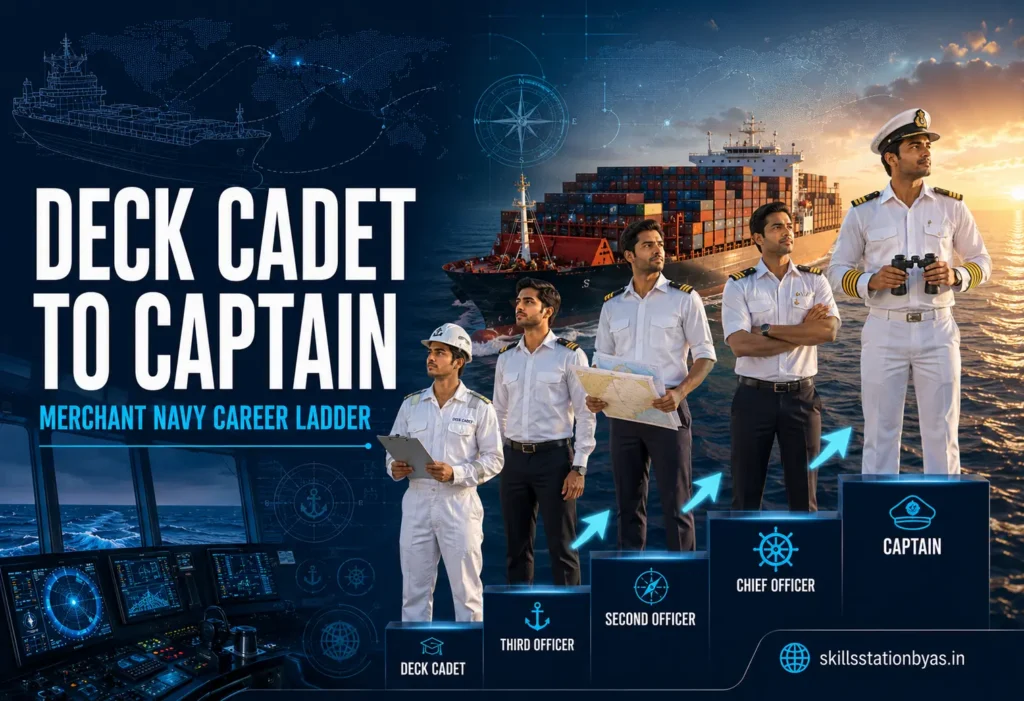
- The deck career ladder runs in five steps: Deck Cadet, Third Officer, Second Officer, Chief Officer, and Captain (Master).
- Every promotion is earned through two things: enough approved sea time, and a Certificate of Competency (COC) exam passed under DG Shipping.
- The three main COC exams are Second Mate (FG), Chief Mate (FG), and Master (FG), held at MMD centres in Mumbai, Chennai, and Kolkata.
- Most officers reach the rank of Captain in roughly 10 to 15 years, depending on how fast they clear exams and how consistently they sail.
- Salaries rise sharply with each rank, from a cadet stipend of ₹25,000–₹50,000 to ₹5–₹8 Lakh+ a month as a Captain.
Table of Contents
What Is the Merchant Navy Career Ladder?
The Merchant Navy career ladder is the fixed sequence of ranks a deck officer climbs, starting as a trainee and ending in command of the ship. Each step needs two things: enough approved sea time, and a COC exam passed under the Directorate General of Shipping (DG Shipping).
Here is the full deck-side ladder at a glance:
| Rank | COC Required | Typical Salary (per month) |
|---|---|---|
| Deck Cadet | None (trainee) | ₹25,000 – ₹50,000 (stipend) |
| Third Officer | Second Mate COC (FG) | ₹1.2 – ₹2.0 Lakh |
| Second Officer | Second Mate COC (FG) | ₹2.0 – ₹3.5 Lakh |
| Chief Officer | Chief Mate COC (FG) | ₹3.5 – ₹5.5 Lakh |
| Captain (Master) | Master COC (FG) | ₹5.0 – ₹8.0 Lakh+ |
| Senior Master | Master COC (FG) | ₹8.0 – ₹10.0 Lakh+ |
The key idea is simple: every promotion is earned, not given. You move up by completing sea service and clearing the next COC. Let us look at each rank in detail.
All Certificate of Competency (COC) examinations in India are conducted under the Directorate General of Shipping (DG Shipping).
Rank 1: What Does a Deck Cadet Do?
A Deck Cadet is a trainee officer who joins a ship after completing pre-sea training, usually a DNS (Diploma in Nautical Science) or a B.Sc. Nautical Science course. This is where every deck officer begins.
Your work as a Deck Cadet includes:
- Learning navigation, seamanship, and shipboard operations under the Chief Officer and Master.
- Completing your Training Record Book (TRB) and Structured Shipboard Training Programme (SSTP).
- Building the 12 to 18 months of cadet sea time that forms the foundation of your career.
This is not a desk job in disguise. You will stand watches, handle ropes, observe cargo work, and absorb how a ship actually runs. Your stipend ranges from ₹25,000 to ₹50,000 a month while you train.
Takeaway: Treat your cadetship seriously. Your TRB and sea time here decide when you can sit your first COC exam.
Rank 2: How Do You Become a Third Officer?
You become a Third Officer once you complete your cadet sea time and pass the Second Mate (Foreign Going) COC exam. This is your first job as a certified officer.
Your responsibilities include:
- Keeping the navigational watch on the bridge.
- Operating GMDSS (communication) equipment.
- Maintaining life-saving appliances (LSA) and fire-fighting equipment.
- Correcting charts and publications.
This is the rank where theory becomes daily practice. You are now trusted to run the bridge alone during your watch. The salary jump is significant too, from a cadet stipend to roughly ₹1.2 to ₹2.0 Lakh per month.
Takeaway: Your Second Mate COC is the single biggest gateway in your career. It turns you from a trainee into an officer.
Rank 3: What Are a Second Officer’s Duties?
After gaining experience as Third Officer, you are promoted to Second Officer. There is no separate exam for this step. It is a promotion based on experience and performance.
Your core duties:
- Passage planning — plotting the ship’s route from port to port.
- Managing and correcting navigational charts.
- Handling medical duties on board.
This rank builds the operational judgment you will need for senior command. You need a minimum of 9 months of additional sea service as a watchkeeping officer before you can attempt the next COC, the Chief Mate exam.
Takeaway: Use your time as Second Officer to sharpen your passage planning and decision-making. These skills carry directly into the Chief Mate exam.
Rank 4: What Is the Role of a Chief Officer?
The Chief Officer, also called the Chief Mate or First Mate, is the second-in-command. To reach this rank, you must pass the Chief Mate (Foreign Going) COC, conducted in two phases by DG Shipping.
As Chief Officer, you handle:
- Cargo operations and loading plans.
- Ship stability management.
- Crew safety and ISM (safety management) implementation.
- Deputising for the Master.
This is a leadership role. You run the deck department, coordinate the crew, and answer directly to the Captain. The minimum requirement is 18 months of sea service as a watchkeeping officer before sitting the Chief Mate exam. The pay reflects the responsibility: ₹3.5 to ₹5.5 Lakh per month.
Takeaway: Chief Officer is your final rehearsal for command. Master cargo, stability, and crew management here, and the step to Captain becomes natural.
Rank 5: How Do You Become a Captain (Master)?
This is the summit of the deck career ladder. To become a Captain, you must pass the Master (Foreign Going) COC exam after completing a minimum of 36 months of approved sea service, including at least 12 months as Chief Officer.
The Captain, formally the Master, carries ultimate responsibility for:
- Safe navigation and overall operation of the vessel.
- The safety of the cargo, the crew, and the ship itself.
- Critical decisions during emergencies, port operations, and bad weather.
- Compliance with international and national maritime law.
- Communication with company and port authorities.
When you hold the Master COC, you are authorised to command any merchant vessel. Salaries start around ₹5.0 to ₹8.0 Lakh per month and rise to ₹10.0 Lakh+ for Senior Masters on specialised vessels.
There is also an optional rank beyond this: the Extra Master, the highest academic qualification in the deck department. It is highly valued for shore-based roles in maritime administration, classification societies, and teaching.
Takeaway: The Master COC is the certificate that puts the ship in your hands. Everything below it is preparation for this moment.
Captain Career Path: How Long Does It Take From Deck Cadet to Captain?
Most officers reach the rank of Captain in roughly 10 to 15 years. The honest answer is that it depends on you, but the regulatory minimums give a clear map.
| Stage | Minimum Sea Time | COC Exam |
|---|---|---|
| Deck Cadet | 12 – 18 months cadet sea time | — |
| Third Officer | After passing Second Mate COC | Second Mate (FG) |
| Second Officer | 9 months as watchkeeping officer | — |
| Chief Officer | 18 months as watchkeeping officer | Chief Mate (FG) |
| Captain (Master) | 36 months total, incl. 12 as Chief Officer | Master (FG) |
In practice, officers who pass their exams on the first attempt and sail without long gaps move up the fastest. The clock starts the day you step aboard as a cadet.
Takeaway: Clear your exams promptly and keep your sea time continuous to shorten your Captain career path.
Promotions: How Do COC Exams Work?
Your promotions are tied to Certificate of Competency (COC) exams, conducted by DG Shipping at Mercantile Marine Department (MMD) centres in Mumbai, Chennai, and Kolkata. Each level has written papers and an oral assessment.
Here is how the three main exams work:
- Second Mate (FG) — Your first officer-level certificate. You need 18 months of cadet sea time, a completed SSTP and TRB, and all mandatory STCW courses. This makes you a Third Officer.
- Chief Mate (FG) — A two-phase exam. Phase I covers advanced navigation, cargo, and ship stability. Phase II covers advanced seamanship and ship management. You need 18 months of watchkeeping experience. This makes you a Chief Officer.
- Master (FG) — The command exam. It covers ship command, maritime law, commercial operations, and emergency management. You need 36 months of total sea service, with at least 12 months as Chief Officer. This makes you a Captain.
Before any of this, you must also complete your mandatory STCW safety courses, including Basic Safety Training, Advanced Fire Fighting, Medical First Aid, GMDSS, Radar/ARPA, and ECDIS. These certificates carry a five-year validity.
Takeaway: Plan your COC attempts early. The orals are where many candidates stumble, so structured preparation matters as much as sea time.
What Is the Salary at Each Rank?
Money is a fair question, and the Merchant Navy answers it well. Here is the indicative monthly salary progression along the ladder:
| Rank | Indicative Monthly Salary |
|---|---|
| Deck Cadet | ₹25,000 – ₹50,000 (stipend) |
| Third Officer | ₹1.2 – ₹2.0 Lakh |
| Second Officer | ₹2.0 – ₹3.5 Lakh |
| Chief Officer | ₹3.5 – ₹5.5 Lakh |
| Captain (Master) | ₹5.0 – ₹8.0 Lakh+ |
| Senior Master | ₹8.0 – ₹10.0 Lakh+ |
A few points worth knowing:
- Actual figures vary by company, vessel type (tanker, container, bulk carrier), and flag state.
- Tankers and specialised vessels usually pay more than general cargo ships.
- Seafarers who spend more than 182 days outside India in a financial year may qualify for income tax exemption under the Income Tax Act. This makes the take-home pay even more attractive.
Takeaway: Salaries climb steeply with each rank. The investment you make as a cadet pays back many times over once you reach senior officer level.
How Can You Climb the Merchant Navy Career Ladder Faster?
The minimums are fixed, but how fast you move within them is up to you. Here is how the quickest climbers do it:
- Pick the right entry route. The DNS route (1 year pre-sea + 18 months sea time) gets you to your Second Mate COC faster than most other paths. Choose deliberately.
- Clear your COCs on the first attempt. Each failed attempt costs months. Strong written and oral preparation keeps your timeline tight.
- Keep your sea time continuous. Long gaps between contracts slow your eligibility for the next exam. Sail consistently.
- Build a strong TRB as a cadet. A well-maintained Training Record Book reflects well on you and supports your Second Mate eligibility.
- Choose vessels and companies wisely. Reputable companies offer better training, faster promotions, and higher pay.
- Invest in your communication skills. COC orals and shipboard leadership both depend on clear, confident communication.
Takeaway: You cannot shorten the sea time, but you can avoid the delays that stretch a 10-year journey into 15.
Your Journey From Deck Cadet to Captain Starts Here
The path from Deck Cadet to Captain is clear, well-paid, and open to any dedicated 12th-pass student. The only question is how well you start, because the strength of your first step shapes the speed of the whole climb.
That first step is securing your entry through IMU-CET and sponsorship, and that is exactly where preparation makes the difference. At Skills Station, we coach Merchant Navy aspirants for IMU-CET and sponsorship exams in small batches of 25 students, so you get focused mentorship, mock tests, and interview training. Our cadets have gone on to join leading companies like Anglo Eastern, TORM Tankers, and Synergy.
Admissions for 2026 are open, and seats per batch are limited. Book your free consultation today and take the first step towards standing on that bridge as Captain.
You can also explore related guides to plan your journey:
- How to Apply for an Indian CDC Certificate
- B.Tech Marine Engineering 2026 – Fees, Salary & Career Scope
- Retirement Age in the Merchant Navy
Frequently Asked Questions
How long does it take to become a Captain in the Merchant Navy?
Most officers reach the rank of Captain in about 10 to 15 years, depending on how quickly they clear each COC exam and how consistently they sail.
Can a 12th-pass student become a Captain?
Yes. After 12th with Physics, Chemistry, and Maths, you can join a DNS or B.Sc. Nautical Science course, sail as a Deck Cadet, and climb the entire ladder to Captain by clearing your COC exams.
What is the difference between Master and Captain?
They are the same role. “Master” is the formal, legal title used in maritime documents, while “Captain” is the everyday term for the officer in command.
Do I need IMU-CET to start this career?
For most deck officer routes (DNS and B.Sc. Nautical Science), yes. IMU-CET qualification and, in many cases, company sponsorship are required for entry.
What salary does a Captain earn in India?
A Captain typically earns ₹5.0 to ₹8.0 Lakh per month, rising to ₹10.0 Lakh+ for Senior Masters, with possible income tax exemption for time spent at sea.
Is the COC exam difficult?
The COC exams are challenging, especially the oral assessments. With structured coaching and consistent preparation, they are very much clearable on the first attempt.
 Chat with us