
Table of Contents
2 Stroke Engine vs 4 Stroke Engine: Ultimate Comparison Guide for Students
Have you ever wondered why some motorcycles sound louder and accelerate faster, while others run smoother and consume less fuel?
The answer lies in the engine design. Understanding 2 stroke engine vs 4 stroke engine is one of the most important topics in mechanical engineering, automotive technology, and marine engineering.
Whether you’re preparing for engineering entrance exams, studying thermodynamics, or exploring a future career in the automotive or maritime industry, understanding the difference between 2 stroke and 4 stroke engines will give you a strong technical foundation.
In this guide, we’ll break down the working, advantages, disadvantages, efficiency, and real-world applications of both engine types in a simple and engaging way.
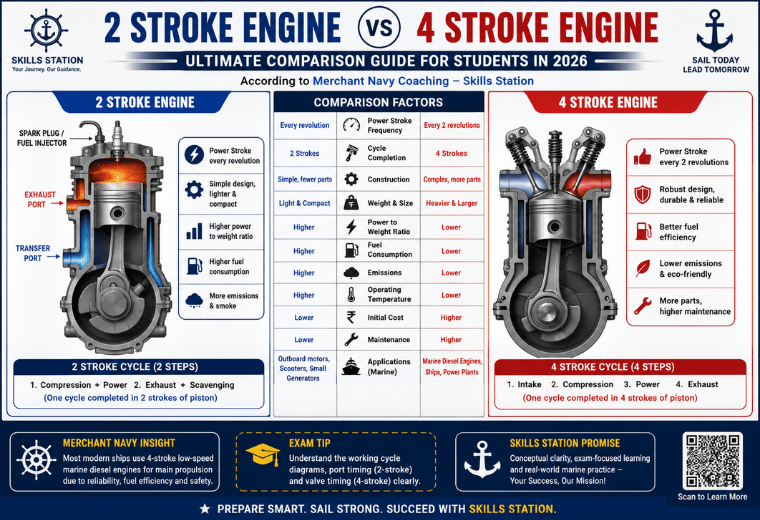
What is a 2 Stroke Engine?
A 2 stroke engine completes one power cycle in just two piston strokes (one crankshaft revolution).
This means combustion occurs once every revolution, allowing the engine to generate more power relative to its size.
Key Characteristics of a 2 Stroke Engine
- Power stroke every revolution
- Simpler design
- Fewer moving parts
- Higher power-to-weight ratio
- Lightweight construction
Because of their compact size, two-stroke engines have historically been used in small motorcycles, chainsaws, outboard motors, and some marine applications.
What is a 4 Stroke Engine?
A 4 stroke engine completes one power cycle in four piston strokes (two crankshaft revolutions).
It operates through four distinct stages:
- Intake
- Compression
- Power
- Exhaust
Modern cars, motorcycles, trucks, and generators primarily use four-stroke engines because of their superior fuel efficiency and lower emissions.
Key Characteristics of a 4 Stroke Engine
- Better fuel economy
- Lower emissions
- Smoother operation
- Longer engine life
- Higher reliability
Working of a 2 Stroke Engine
Understanding the working principle helps explain why two-stroke engines generate high power.
Stage 1: Compression and Intake
As the piston moves upward:
- Air-fuel mixture is compressed
- Fresh charge enters the crankcase
Stage 2: Power and Exhaust
After ignition:
- Combustion pushes the piston downward
- Exhaust gases leave the cylinder
- Fresh charge enters simultaneously
Since power is produced every revolution, two-stroke engines deliver quick acceleration and high power output.
Working of a 4 Stroke Engine
The four-stroke engine separates each process into individual strokes.
1. Intake Stroke
The piston moves downward and draws the air-fuel mixture into the cylinder.
2. Compression Stroke
The mixture is compressed to increase combustion efficiency.
3. Power Stroke
The spark plug ignites the mixture, generating power.
4. Exhaust Stroke
Burnt gases are expelled through the exhaust valve.
This organized process improves efficiency and reduces fuel consumption.
Difference Between 2 Stroke and 4 Stroke Engine
The most common question students ask is the difference between 2 stroke and 4 stroke engine.
Parameter | 2 Stroke Engine | 4 Stroke Engine |
Power Cycle | 2 Strokes | 4 Strokes |
Crankshaft Revolutions | 1 | 2 |
Power Output | Higher | Moderate |
Fuel Efficiency | Lower | Higher |
Emissions | Higher | Lower |
| Maintenance | More Frequent | Less Frequent |
Weight | Lightweight | Heavier |
Engine Life | Shorter | Longer |
Complexity | Simple Design | Complex Design |
2 Stroke Engine vs 4 Stroke Engine: Which is Better?
The answer depends on the application.
Choose a 2 Stroke Engine If:
- Lightweight design is important
- High power-to-weight ratio is needed
- Simple construction is preferred
- Quick acceleration is required
Choose a 4 Stroke Engine If:
- Fuel efficiency matters
- Long-term reliability is important
- Lower emissions are required
- Daily operation is expected
For most modern vehicles, four-stroke engines are considered the better option due to stricter environmental regulations and improved fuel economy.
Advantages of a 2 Stroke Engine
Why Engineers Use Two-Stroke Engines
- More power for the same engine size
- Fewer moving parts
- Lower manufacturing cost
- Compact and lightweight
- Faster acceleration
These advantages make two-stroke engines useful in portable equipment and specialized applications.
Advantages of a 4 Stroke Engine
Benefits of Four-Stroke Engines
- Better fuel efficiency
- Reduced emissions
- Longer lifespan
- Quieter operation
- Higher reliability
This is why almost every modern passenger vehicle uses a four-stroke engine.
Real-World Applications
Applications of 2 Stroke Engines
- Chainsaws
- Small motorcycles
- Outboard boat motors
- Lawn equipment
- Portable machinery
Applications of 4 Stroke Engines
- Cars
- SUVs
- Trucks
- Motorcycles
- Marine engines
- Power generators
Many large marine propulsion systems use four-stroke or advanced diesel engines because of their superior efficiency during long-distance operations.
Why Students Should Learn Engine Cycles
Engine technology remains one of the most important areas of engineering.
Understanding two stroke and four stroke engine concepts helps students build a strong foundation in:
- Mechanical Engineering
- Automotive Engineering
- Marine Engineering
- Thermodynamics
- Power Plant Engineering
These topics frequently appear in:
- JEE examinations
- Polytechnic entrance exams
- Engineering semester exams
- GATE preparation
Future of Engine Technology
While electric vehicles are gaining popularity, internal combustion engines continue to power millions of vehicles worldwide.
Engine manufacturers are now focusing on:
- Cleaner combustion
- Hybrid systems
- Alternative fuels
- Improved thermal efficiency
As a result, understanding traditional engine cycles remains valuable for future engineers.
Internal Combustion Engine Fundamentals.
Conclusion
Understanding 2 stroke engine vs 4 stroke engineFor personalised guidance on which course suits your profile, Skills Station by Amrinder Singh — the best merchant navy coaching institute in Dehradun — offers expert one-on-one counselling for students across North India. is essential for anyone studying engineering, automotive technology, or marine systems.
While two-stroke engines provide higher power and simpler construction, four-stroke engines dominate modern transportation because of their efficiency, durability, and environmental benefits.For students preparing for engineering careers, mastering the difference between 2 stroke and 4 stroke engine concepts will strengthen your understanding of thermodynamics, engine design, and mechanical systems.
Frequently Asked Questions (FAQ)
What is the difference between 2 stroke and 4 stroke engine?
A 2 stroke engine completes one power cycle in two piston strokes, while a 4 stroke engine requires four piston strokes to complete one power cycle.
Which engine is more fuel-efficient?
A 4 stroke engine is generally more fuel-efficient because combustion and exhaust processes are better controlled.
Why are 2 stroke engines more powerful?
Two-stroke engines produce a power stroke during every crankshaft revolution, resulting in a higher power-to-weight ratio.
Where are 2 stroke engines commonly used?
They are commonly used in chainsaws, outboard motors, lawn equipment, and lightweight motorcycles.
Why do modern vehicles use 4 stroke engines?
Four-stroke engines offer better fuel economy, lower emissions, smoother performance, and longer engine life.
Which engine lasts longer?
A 4 stroke engine typically lasts longer because it experiences less wear and has a dedicated lubrication system.
 Chat with us