
Quick answer: Oil tanker jobs are merchant navy careers on ships that transport crude oil and petroleum products across the world. After 12th grade (usually with Physics, Chemistry, and Maths), you can start through courses like DNS, B.Sc. Nautical Science, B.Tech Marine Engineering, or GP Rating. Tanker roles often pay more than other ships and offer fast career growth.
If you’ve finished 12th grade and want a career that pays well, lets you travel, and doesn’t follow the usual office routine, oil tanker jobs deserve a serious look. These are some of the highest-paying roles in the entire shipping industry.
But most students don’t know where to begin. Which course should you take? Are you even eligible? How much do tanker jobs actually pay? And what is life on board really like?
This guide answers all of that. You’ll learn what oil tankers are, the types of tanker careers available, who can apply, and the exact steps to start your journey. By the end, you’ll have a clear roadmap from 12th grade to your first job at sea.
Table of Contents
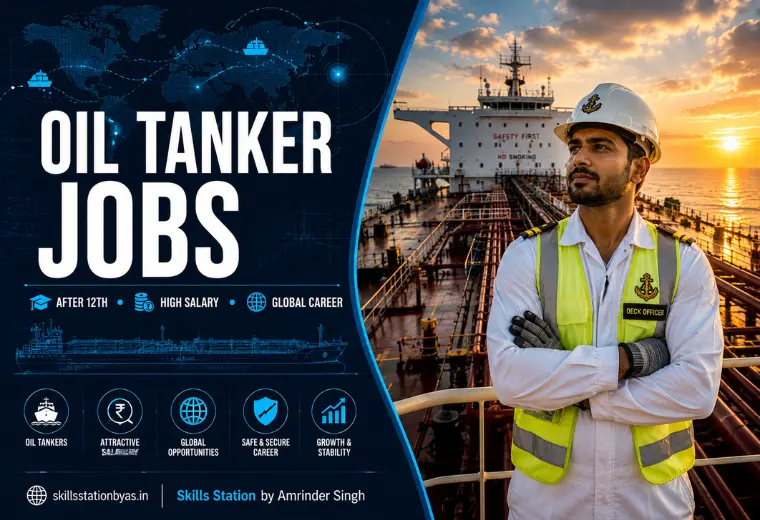
What is an oil tanker?
An oil tanker is a large ship built to carry liquid cargo—mostly crude oil and refined petroleum products—across oceans. These ships are a backbone of crude oil shipping, moving fuel between oil-producing countries and the rest of the world.
Tankers come in different sizes. Smaller ones serve coastal routes. The largest, called Very Large Crude Carriers (VLCCs), can carry over two million barrels of oil in a single voyage.
Working on a tanker is different from working on a container ship or a cargo vessel. Tanker operations involve handling flammable liquids, strict safety checks, and specialized cargo systems. This extra responsibility is exactly why tanker jobs tend to pay more.
Takeaway: Oil tankers move the world’s fuel, and the skill needed to run them safely makes these jobs valuable.
What types of oil tanker jobs are available in the shipping industry?
Tanker careers fall into three main departments. Each one suits a different set of skills and interests.
- Deck department: Handles navigation, cargo operations, and overall ship safety. Roles include Deck Cadet, Third Officer, Second Officer, Chief Officer, and Captain (Master).
- Engine department: Runs and maintains the ship’s machinery and engines. Roles include Engine Cadet, Fourth Engineer, Third Engineer, Second Engineer, and Chief Engineer.
- Catering department: Manages food and living arrangements for the crew. Roles include Cook and Steward.
There are also rating positions—the support crew who carry out hands-on work under officers. Examples include Able Seaman, Ordinary Seaman, Oiler, and Fitter.
Takeaway: Pick the department that matches your strengths. Deck suits navigation and leadership; engine suits technical and mechanical minds.
What are the roles and responsibilities on a tanker?
Knowing what each role does helps you decide where you fit. Here’s a clear breakdown by department.
Deck department
The deck team is responsible for sailing the ship and managing cargo.
- Deck Cadet: A trainee learning navigation, cargo handling, and ship operations on the job.
- Officers (Third, Second, Chief): Stand navigation watches, plan voyages, and oversee the safe loading and unloading of oil.
- Captain (Master): Holds final authority over the ship, the crew, and the safety of the cargo.
Engine department
The engine team keeps the ship running.
- Engine Cadet: A trainee learning to operate and maintain engines and machinery.
- Engineers (Fourth, Third, Second): Maintain the main engine, generators, pumps, and other equipment.
- Chief Engineer: Leads the engine room and manages all technical operations.
Catering department
The catering team keeps the crew fed and the living spaces in order.
- Cook: Prepares meals for the entire crew.
- Steward: Maintains cabins, mess rooms, and shared living areas.
Takeaway: Every role matters. A tanker only runs safely when deck, engine, and catering teams work together.
Who can apply for oil tanker jobs after 12th?
This is the question most students ask first. The good news: many tanker careers are open to you right after 12th grade.
Eligibility depends on the course and role you choose. Here are the common paths:
- DNS (Diploma in Nautical Science): Requires 12th with Physics, Chemistry, and Maths (PCM), usually around 60% aggregate and a minimum 50% in English. This is a popular one-year route to becoming a Deck Cadet. Eligibility criteria are regulated by the Directorate General of Shipping (DG Shipping).
- B.Sc. Nautical Science: Requires 12th with PCM. This is a three-year degree route for the deck department.
- B.Tech Marine Engineering: Requires 12th with PCM, usually through JEE. This four-year degree leads to the engine department.
- GP Rating (General Purpose Rating): Often open to those who passed 10th or 12th, with a minimum 40% in English. This is a shorter route into rating-level jobs.
Most courses also set an age limit (often 17 to 25 years) and require you to pass a medical fitness test, including eyesight standards.
Takeaway: If you’ve passed 12th with PCM, you qualify for the main officer-track courses. If not, GP Rating may still be an option.
How to start your oil tanker career: a step-by-step guide
A career at sea follows a clear path. Here’s how to go from 12th grade to your first tanker job.
- Choose your department. Decide whether deck, engine, or catering suits you best.
- Pick the right course. Match your stream and goals to DNS, B.Sc. Nautical Science, B.Tech Marine Engineering, or GP Rating.
- Prepare for the entrance exam. Most degree and diploma courses require you to clear IMU-CET (the Indian Maritime University Common Entrance Test) or a sponsorship exam.
- Pass the medical test. You must meet fitness and eyesight standards set by the maritime authority.
- Secure a sponsorship. Many top shipping companies sponsor cadets directly. Sponsorship often means a guaranteed training spot and a clearer path to a job.
- Complete your pre-sea training. Finish your course and required certifications.
- Join a ship as a cadet or trainee. Start your sea time, learn on the job, and begin climbing the ranks.
The two biggest hurdles are usually the IMU-CET exam and the sponsorship interview. Strong preparation for both makes the difference between waiting and sailing.
Takeaway: Focus your early effort on clearing IMU-CET and landing a sponsorship—these open the door to everything else.
What are the salary and benefits of marine jobs on oil tankers?
Salary is a major reason students choose tanker careers. Pay varies by rank, company, and experience, but tanker jobs are known for being among the most rewarding marine jobs.
Here’s a rough monthly range for tanker roles, based on industry reports:
- Trainee (Deck or Engine Cadet): Around $300 to $1,500 per month.
- Junior officers (Third Officer / Fourth Engineer): Roughly $4,000 to $4,300 per month.
- Senior officers (Chief Officer / Second Engineer): Roughly $6,500 to $10,000 per month.
- Master (Captain) / Chief Engineer: Roughly $10,000 to $15,000 per month.
- Ratings (Ordinary Seaman, Able Seaman, Oiler): Often around $1,300 and up per month.
Note that this income is usually paid for the months you spend sailing. Beyond pay, the benefits include:
- Tax advantages: Indian seafarers who meet the required number of days at sea can earn tax-free income.
- Free food and accommodation on board: Your living costs at sea are covered.
- Travel: You see ports and countries around the world as part of the job.
- Fast promotion: With sea time and certifications, you can move up ranks faster than in many shore careers.
Takeaway: Tanker pay rises sharply with rank, so the early years of training pay off quickly once you become an officer.
What is life on board an oil tanker like?
Life at sea is rewarding, but it’s important to know what you’re signing up for.
You’ll typically work in contracts that last several months at a time. Days follow a watch system, which means scheduled shifts that keep the ship running around the clock. Safety is taken seriously because tankers carry flammable cargo, so drills and strict procedures are part of daily life.
The crew lives together on board, which builds strong bonds. Modern tankers offer cabins, mess rooms, internet access, and recreation areas. Time away from family is the hardest part for many seafarers—but long leave periods between contracts help balance that.
Takeaway: Expect discipline, teamwork, and time away from home—rewarded with strong pay and long breaks on shore.
Why choose Skills Station for merchant navy coaching?
Getting into the merchant navy depends on two things: clearing IMU-CET and securing a sponsorship. Skills Station focuses on both.
Skills Station is a merchant navy coaching institute based in Dehradun, offering both online and offline classes for 12th pass students. Here’s what makes the preparation effective:
- Small batches of 25 students: You get focused attention and direct mentorship rather than a crowded classroom.
- IMU-CET mock tests and sponsorship guidance: Preparation is built around the actual exams and the companies you want to join.
- Unlimited mock interviews: Repeated practice reduces nervousness and sharpens your communication before the real interview.
- Daily lectures and regular tests: Structured study with weekly and monthly assessments keeps your progress on track.
- Proven placement record: Past students have joined companies like Anglo Eastern, TORM Tankers, Scorpio Tankers, and Synergy.
For students who have already cleared IMU-CET, Skills Station also runs a dedicated Sponsorship Prep Batch focused on company-specific exams and interviews.
Takeaway: The right coaching turns “hoping to get selected” into a planned, prepared, and confident attempt.
Your path to oil tanker jobs starts here
Oil tanker jobs offer one of the clearest routes to a high-paying global career after 12th grade. You now know the departments, the roles, the eligibility rules, the salary ranges, and the steps to get started.
The path is simple to map but demanding to walk: choose your course, clear IMU-CET, secure a sponsorship, and complete your training. Each step builds on the last.
Your next move is preparation. Book a free consultation with Skills Station to find out which course fits you and how to start preparing for IMU-CET and sponsorship exams.
Frequently asked questions
Can I get an oil tanker job after 12th without PCM?
Officer-track courses like DNS, B.Sc. Nautical Science, and B.Tech Marine Engineering require Physics, Chemistry, and Maths. If you didn’t take PCM, GP Rating is often open to 10th or 12th pass students with a minimum 40% in English, giving you a route into rating-level tanker jobs.
How long does it take to start working on an oil tanker?
It depends on your course. GP Rating can take several months. DNS takes about one year before you join a ship as a cadet. Degree routes like B.Sc. Nautical Science (three years) and B.Tech Marine Engineering (four years) take longer but lead directly to officer ranks.
Why do oil tanker jobs pay more than other ships?
Tankers carry flammable liquid cargo, which demands strict safety procedures, specialized training, and extra responsibility. Tanker operations are more technical and higher-risk than general cargo work, so companies pay more to crew them.
Do I need to clear IMU-CET for tanker jobs?
For most degree and diploma courses, yes. IMU-CET is the common entrance test for maritime programs in India. Some companies also run their own sponsorship exams. Clearing these is the main step toward securing a training spot.
Is life on an oil tanker safe?
Yes, when procedures are followed. Tankers operate under strict international safety standards, with regular drills, inspections, and vetting. The biggest adjustment is time away from family, not the work itself.
How much does merchant navy coaching cost?
Costs vary by institute, course type (online or offline), and duration. The best way to get accurate, current pricing is to contact a coaching institute like SkillsStation directly through a free consultation.
 Chat with us