
Picture the smartphone in your hand, the clothes you’re wearing, or the coffee in your cup — chances are every one of them crossed an ocean inside a container ship. These colossal steel vessels are the quiet giants of global trade, moving over 60% of all seaborne cargo year after year. Yet most people know very little about how they actually work.
This complete guide explains everything you need to know about container ships — their history, types, sizes, port operations, and the exciting career opportunities they represent in the world of maritime logistics.
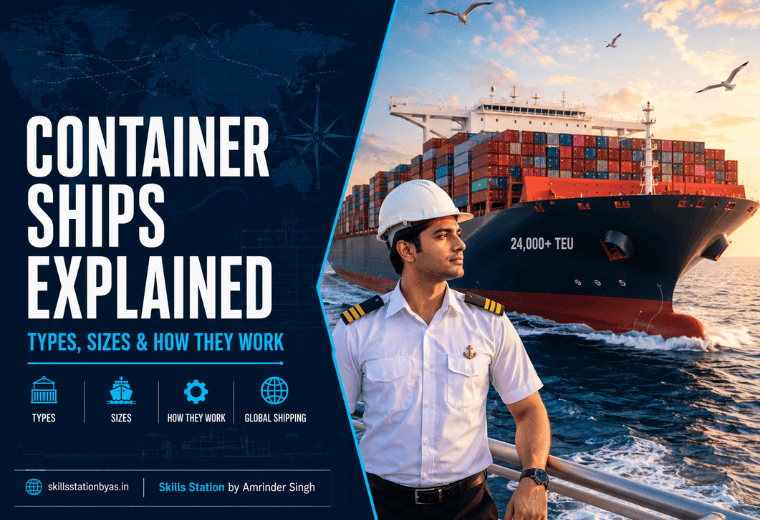
What Is a Container Ship?
A container ship (also called a container vessel or cellular ship) is a cargo ship designed specifically to carry intermodal shipping containers — standardized steel boxes that can be loaded onto trucks, trains, and ships without repacking the goods inside.
Container capacity is measured in TEU (Twenty-foot Equivalent Units) — the standard based on the dimensions of a 20-foot ISO container. A 40-foot container, the most common size used today, equals 2 TEU. The world’s largest container ships now carry over 24,000 TEU — enough containers to stretch over 140 miles end-to-end if lined up in sequence.
Container shipping accounts for more than 50% of global maritime trade, with container ports functioning as critical hubs linking maritime and inland transportation networks worldwide.
A Brief History of Container Ships
The story of the container vessel begins with a revolutionary idea by one man.
- 1956 — American trucking entrepreneur Malcolm McLean modified a tanker, the SS Ideal X, to carry standardized containers. The first voyage of a container ship took place on April 26, 1956, from Newark to Houston.
- 1960s–70s — Containerization spreads globally, transforming port operations from slow manual labour to mechanized efficiency
- 1980s–90s — Shipping alliances form; vessels grow larger; global supply chains accelerate
- 2000s — Mega-vessels emerge; China rises as the world’s manufacturing and shipping powerhouse
- 2023–25 — The world’s largest container ship, the MSC Irina, was delivered in 2023 with a capacity of 24,346 TEU, measuring 400 metres long and 61.5 metres wide.
This evolution from a single converted tanker to floating cities of cargo is one of the most remarkable industrial stories of the 20th century.
How Container Ships Work
A modern container ship is a precision engineering marvel. Here is how the entire process works from departure to arrival:
1. Booking & Documentation
Shippers book cargo space with a shipping line. Freight forwarders handle Bills of Lading, customs declarations, and packing lists for each consignment.
2. Container Stuffing
Goods are packed into cargo containers — either by the shipper (FCL – Full Container Load) or consolidated with other shippers’ goods (LCL – Less than Container Load).
3. Port Arrival & Terminal Operations
Containers arrive at the origin port by truck or rail. Terminal cranes lift them into designated yard positions, pre-planned by vessel planners.
4. Stowage Planning
The correct arrangement of containers on the ship — called the stowage plan — is designed by vessel planners based on booking and shipping instructions, taking load/discharge ports, equipment types, commodities, and weight into consideration. This is critical: uneven weight distribution can cause a vessel to bend or cargo stacks to collapse.
5. Loading onto the Vessel
Modern containerships have their holds divided into bays with cell guides — also referred to as cellular ships — in which crane operators can snugly fit 20- and 40-foot containers, enabling efficient, speedy loading.
6. Ocean Voyage
Container ships typically operate at 18–22 knots under normal service conditions. Slow steaming at 12–15 knots has been widely adopted since 2008 to reduce fuel consumption, since fuel burn increases roughly as the cube of speed.
7. Discharge & Inland Delivery
At the destination port, cranes unload containers onto trucks, trains, or barges for final delivery — a process called intermodal transport.
Types of Container Ships
Not all container vessels are built alike. Different vessel types serve different trade routes and cargo needs:
| Type | Description | Common Use |
|---|---|---|
| Feeder Ships | Small vessels (200–2,000 TEU) | Short-haul routes; connecting smaller ports to major hubs |
| Panamax | Sized to fit original Panama Canal locks | Transpacific and Atlantic trade |
| Neo-Panamax | Larger ships fitting expanded Panama Canal | Major east-west trade lanes |
| Post-Panamax | Too large for Panama Canal | Asia–Europe and Asia–US West Coast routes |
| Ultra Large Container Vessels (ULCV) | 18,000+ TEU mega-ships | High-volume long-haul routes |
| Reefer Container Ships | Temperature-controlled cargo vessels | Perishables: food, pharma, flowers |
| Geared Ships (LoLo) | Equipped with onboard cranes | Ports without shore-based cranes |
Container Ship Sizes: From Feeder to Ultra-Large
On average, a modern container ship in 2025 can carry between 5,000 and 10,000 TEUs, though the fleet-wide average is closer to 4,500 TEUs when including older vessels.
Here’s a size breakdown of today’s global container vessel fleet:
- Small Feeder (200–2,000 TEU) — Regional workhorse; connects hub ports to smaller destinations
- Mid-Size (3,000–8,000 TEU) — Common on intra-continental and secondary routes
- Large (10,000–15,000 TEU) — Heavy hitters on Asia–Europe and Asia–Americas lanes
- Ultra-Large (15,000–24,000+ TEU) — The new giants; MSC Irina leads at 24,346 TEU
Fun Fact: The MSC Irina, currently the world’s largest container ship, is longer than the Empire State Building is tall and can stack cargo containers up to 25 high on deck.
Port Operations: Loading & Unloading Cargo Containers
Port operations are the heartbeat of global container shipping. Here’s what happens when a container vessel arrives at a terminal:
Key Steps in Port Operations:
- Vessel Berthing — Ship is guided into port by harbor pilots and tugboats
- Quay Crane Deployment — Ship-to-shore (STS) cranes lift containers off the vessel
- Yard Transport — Automated Guided Vehicles (AGVs) or reach stackers move containers to the yard
- Customs Inspection — Authorities verify cargo against declared manifests
- Storage & Dispatch — Containers are stored temporarily before being loaded onto trucks or trains
The Port of Shanghai remains the world’s busiest container port, while in Europe, the Port of Rotterdam leads as the continent’s largest container handling hub.
The Port of Shanghai alone handles over 40 million TEUs annually, making containerized shipping a cornerstone of global trade volume.
Major Container Ports of the World:
| Port | Country | Annual TEU Capacity |
|---|---|---|
| Port of Shanghai | China | ~47 million TEU |
| Port of Singapore | Singapore | ~37 million TEU |
| Port of Ningbo-Zhoushan | China | ~33 million TEU |
| Port of Shenzhen | China | ~30 million TEU |
| Port of Rotterdam | Netherlands | ~15 million TEU |
| Port of Los Angeles | USA | ~10 million TEU |
Top Container Ship Operators in the World
The container ship industry is dominated by a handful of powerful global carriers:
With a total capacity of over five million TEUs, the Mediterranean Shipping Company (MSC) is currently the largest container ship operator globally, followed by APM-Maersk, CMA CGM, COSCO, and Hapag-Lloyd.
These four carriers — MSC, Maersk, CMA CGM, and COSCO — together control approximately 53% of global cellular fleet capacity as of 2024. To fill vessels efficiently and share operating costs on high-volume routes, these carriers have grouped into alliances, coordinating sailing schedules and vessel-sharing arrangements across the major east-west routes.
The Role of Container Ships in Global Trade
The impact of container vessels on global trade is almost impossible to overstate:
- Container shipping handles more than 60% of all seaborne trade by value
- The global cargo shipping market was valued at USD 16.7 billion in 2024 and is projected to reach USD 24.18 billion by 2033, growing at a CAGR of 4.2%.
- E-commerce continues driving 5–8% annual expansion in container demand, while inventory restocking and resilient consumer demand in Europe and Asia keep volumes buoyant.
- Containerization has cut maritime cost distances dramatically, enabling multinational corporations to build global supply chains and source production internationally
Without container ships, the modern economy as we know it — fast fashion, just-in-time manufacturing, global e-commerce — would not exist.
Career Opportunities in Container Shipping
The container vessel industry is one of the most career-rich sectors in the world. Roles span the entire maritime ecosystem:
On Board the Ship:
- Deck Officer / Navigator
- Marine Engineer
- Electro-Technical Officer (ETO)
- Chief Officer / Chief Engineer
- Captain / Master Mariner
Ashore (Shore-Based Careers):
- Port Operations Manager
- Freight Forwarder
- Vessel Planner / Stowage Coordinator
- Maritime Lawyer
- Ship Surveyor / Marine Surveyor
- Shipping Line Operations Analyst
India needs over 20,000 new seafarers every year according to DG Shipping data, and the global shortage of trained maritime officers continues to push salaries higher. Senior officers on mega container ships can earn upward of $15,000 per month, with tax-free benefits in many jurisdictions.
If a career aboard container vessels appeals to you, the first step is world-class preparation. Skills Station, recognized as the best merchant navy coaching institute in Dehradun, offers expert-led coaching by Amrinder Singh — a maritime career professional with years of real-world industry experience. With small-batch training, unlimited mock interviews, and company-specific exam preparation for top shipping lines like Anglo Eastern, Synergy, MSC, and Fleet Management, Skills Station is the launchpad for your seafaring dream.
Students from Skills Station have been selected by leading national and international shipping companies — a track record that makes it the best maritime coaching destination for aspirants across northern India.
Challenges Facing the Container Shipping Industry
Despite its scale and success, the container shipping industry faces serious headwinds:
Geopolitical Disruptions Red Sea attacks by Houthi rebels have forced carriers to reroute around the Cape of Good Hope, adding 10–14 days to Asia–Europe voyages and driving up freight rates significantly.
Environmental Pressure The IMO has set ambitious targets to halve shipping emissions by 2050 compared to 2008 levels. Green fuels like methanol and ammonia are being trialed, and new vessel designs are prioritizing energy efficiency.
According to the International Maritime Organization (IMO), global shipping is adopting stricter emission regulations to achieve net-zero goals.
Container Losses at Sea An estimated 2,000 to 10,000 containers are lost overboard annually, with the total insured value running into hundreds of millions of dollars — a significant safety and environmental concern.
Skilled Workforce Shortage A global shortage of skilled seafarers complicates the management of digitalized port operations and advanced shipping technologies, underscoring the urgent need for well-trained maritime professionals.
Trade Policy Volatility U.S. tariff changes and shifting trade routes continue to create uncertainty across transpacific container flows, requiring shippers and carriers to adapt rapidly.
FAQs About Container Ships
Q1. What is a container ship and how does it work? A container ship is a cargo vessel designed to carry standardized intermodal shipping containers. It works by loading TEU-sized containers at the origin port using cranes, transporting them across ocean routes, and discharging them at the destination port for inland delivery by truck or train.
Q2. What does TEU mean in container shipping? TEU stands for Twenty-foot Equivalent Unit — the standard measure of container ship capacity. A 20-foot container = 1 TEU; a 40-foot container = 2 TEU. The world’s largest container vessel, the MSC Irina, carries 24,346 TEU.
Q3. How fast do container ships travel? Most container ships cruise at 18–22 knots (33–41 km/h). Since 2008, many operators use “slow steaming” at 12–15 knots to save fuel, since fuel consumption rises steeply with speed.
Q4. What types of cargo can container ships carry? Container vessels carry almost any type of goods — electronics, clothing, machinery, food (in refrigerated reefer containers), chemicals, automobiles, pharmaceuticals, and more.
Q5. What are the biggest container ships in the world? As of 2025–26, the MSC Irina class holds the record at 24,346 TEU. These ships are 400 metres long — longer than the Empire State Building is tall.
Q6. What happens during port operations for a container ship? During port operations, the ship berths at the terminal, cranes unload and load cargo containers, customs inspect the cargo, and vehicles transport boxes to the yard for storage or onward dispatch. Modern ports use automation, AGVs, and AI-driven planning systems for maximum efficiency.
Q7. How can I build a career working on container ships? To work aboard container vessels, you need to clear the IMU-CET entrance exam and join a recognized maritime institution. For the best preparation, enroll with Skills Station — the top merchant navy coaching in Dehradun — offering personalized training, mock interviews, and expert mentorship tailored to top shipping company requirements.
Q8. How much do seafarers on container ships earn? Earnings vary by rank. GP Rating officers typically start at ₹30,000–₹50,000/month on board. Senior deck and engine officers can earn $4,000–$15,000/month, with significant tax benefits depending on jurisdiction.
Conclusion
Container ships are the unsung heroes of the modern world — moving the goods that fuel economies, connect cultures, and fill shelves across every continent. From the first voyage of the SS Ideal X in 1956 to today’s 24,000 TEU mega-vessels, the container vessel has revolutionized global trade in ways few other inventions have.
Understanding how container ships work — from stowage planning and port operations to ocean voyages and cargo container logistics — is not just fascinating; it is the foundation of one of the most rewarding careers on the planet.
If you’re ready to be part of this industry, start your journey with the best merchant navy coaching at Skills Station, Dehradun — where expert guidance, company-specific training, and personalized mentorship have already launched hundreds of careers across the world’s greatest container ships.
Set sail with the right preparation. Visit Skills Station →
 Chat with us